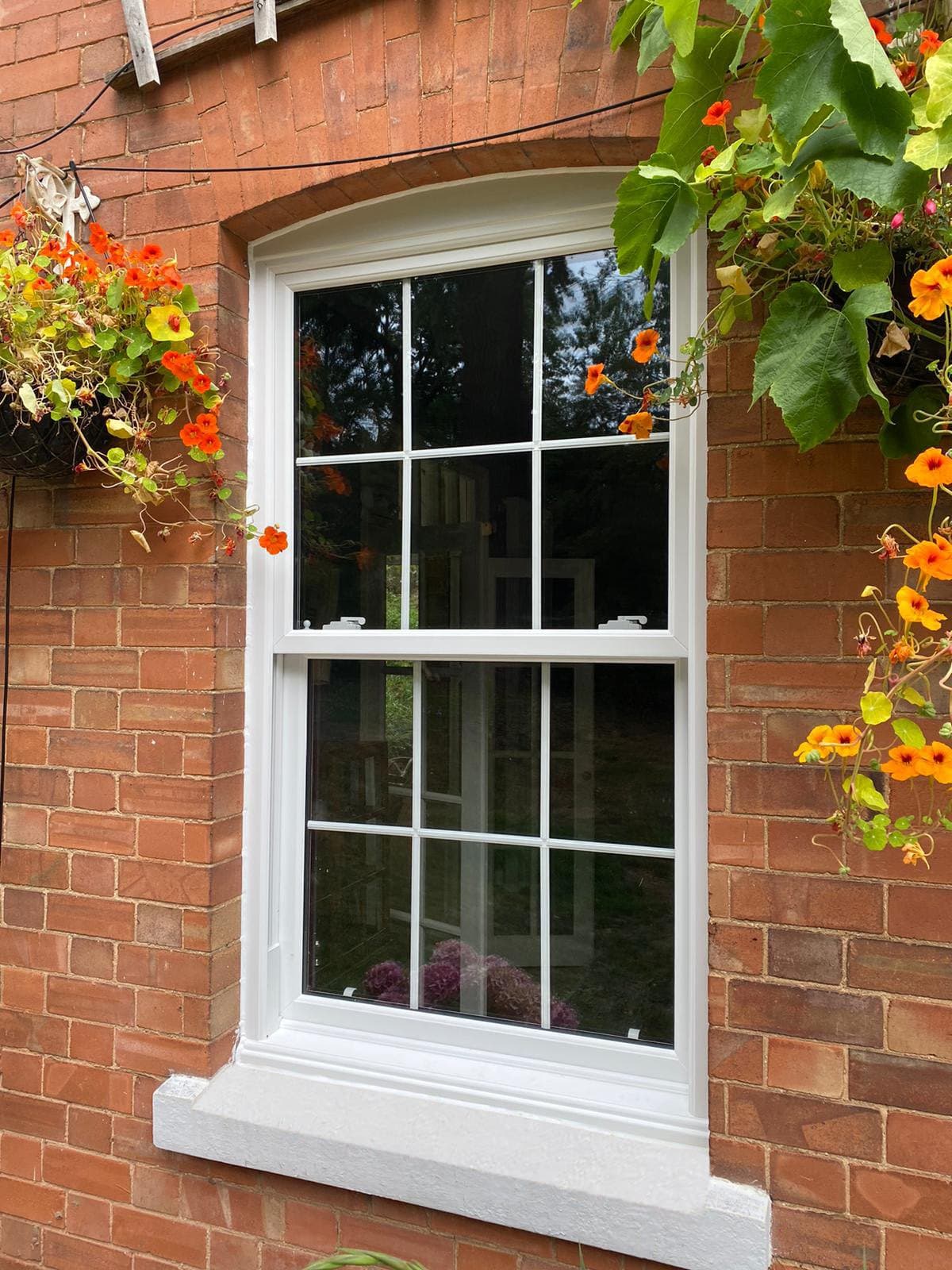
The question behind the question
When someone asks whether uPVC will suit their Victorian terrace, they are rarely asking about plastic. They are asking whether the front of their house will still look like their house afterwards, and whether a neighbour or a passer-by will be able to tell at a glance that something has changed.
That is a fair thing to worry about, because a great many replacement windows do announce themselves. Walk down almost any period street and you can pick out the houses that have had windows done badly. What gives them away is almost never the material. It is proportion.
The four details that actually decide it
A sash window is read by the eye as a set of relationships: how thick the frame looks against the glass, how the panes are divided, how heavy the bottom of the window appears, and how the surface catches light. Get those four right and a replacement settles into an elevation. Get any of them wrong and no amount of quality elsewhere rescues it.
In the order they tend to matter:
- Sightlines. How much frame you see around the glass. A window with visibly fatter frames than its neighbours changes the rhythm of a terrace, and the eye picks it up from the far end of the street. Slim sightlines are specified deliberately rather than hoped for.
- The glazing bar layout. Reproducing the original pane divisions is what keeps an elevation coherent. Georgian bars sit inside the sealed unit, leaving a flat outer face with nothing to maintain. External astragal bars are applied to the outside of the glass and cast a shadow line, which reads far closer to a traditional divided window on a formal frontage.
- A deeper bottom rail. Traditional timber sashes have visual weight at the bottom. Without it a window can look like it is floating in the opening, and on a tall Victorian window that is the single most common thing that reads as wrong. A deeper bottom rail is available and on most period stock it is worth having.
- The finish. A flat white frame is what most people picture when they picture uPVC, and it is the least sympathetic option on an old building. Five of the eleven foils give a genuine woodgrain texture rather than a sheen: Golden Oak, Irish Oak, Rosewood, Cream and Crystal White. Beyond those, any classic RAL shade can be sprayed and Farrow & Ball colours matched.
Specified together, those four are the difference between a replacement nobody notices and one everybody does. They are all decisions, which means they are all decisions you can get right.
Where the material genuinely helps
Once appearance is handled, the practical case is straightforward. Timber sashes on a period house need repainting every few years, and on an exposed elevation more often than that. The foils on these frames are a surface finish rather than a paint film, so maintenance is washing them down.
The performance side is measured rather than claimed. ECOSlide® carries an A+ Window Energy Rating with a U-value of 1.3 W/m²K as standard, or 1.2 with enhanced glazing, both comfortably inside the 1.4 ceiling Approved Document L sets for replacement windows in England. Wind resistance is Class C4 at 1600 Pa tested to BS EN 12211, equivalent to gusts of around 115mph, with air permeability at Class 4 and water tightness at Class 7A under BS 6375-1.
There is also a detail that period houses benefit from more than most: both sashes tilt inwards on two standard tilt knobs, so the outside of an upper window can be cleaned from inside the room. On a three storey terrace with no side access, that is the feature people end up using every few weeks.
Where the honest answer is to slow down
If the building is listed, the local authority decides what is possible through listed building consent, and that conversation belongs before anyone prices a window. The same applies in a conservation area, where the position varies between authorities and sometimes between streets. Establish it first and the specification follows what has been agreed.
It is also worth saying that on some buildings the right answer is a careful timber repair rather than a replacement. A window that is sound and simply tired is not the same as a window that has reached the end of its life, and a surveyor should tell you which one you have.
What to do next
Photograph the front of the house straight on rather than at an angle, and count the panes in one original window. Those two things tell us most of what we need to say something useful about proportion before anyone visits.
Across West London and the Home Counties we survey the openings ourselves before anything is ordered, which moves the risk of a wrong size off you. Anywhere else in Great Britain the windows are made to a schedule of sizes you provide and delivered kerbside for your own fitter.
Questions we get asked
Will neighbours be able to tell the windows have been replaced?
From the pavement, if the pane divisions match, the sightlines are slim and the bottom rail has the right visual weight, most people cannot. What gives a replacement away is proportion rather than material, which is why those three are specified deliberately rather than left to a default.
Are Georgian bars or astragal bars better on a period house?
External astragal bars usually look more convincing on a formal frontage, because they stand proud of the glass and cast a shadow the way an original glazing bar does. Georgian bars inside the sealed unit give the same pattern with a flat outer face and nothing to repaint, which suits plainer elevations and rear windows.
Can the inside be a different colour from the outside?
Yes. Dual colour is available, so a heritage shade can face the street while white or a lighter tone faces the room. Any classic RAL colour can be sprayed and Farrow & Ball shades matched.
Read next
- Replacing sash windows in a conservation area
- Are uPVC sash windows warm?
- Coloured uPVC sash windows
- Survey, supply and fitting
- Areas we cover
Talk to us about your windows
Send a photograph of the front of the property and roughly how many windows are involved, or your schedule of sizes for a supply-only order, and we will tell you what is realistic before anyone comes out.
Call 0800 861 1450, message us on WhatsApp, or email info@sashwindowfactory.co.uk.