Why the schedule is the whole job
Made to measure means exactly that: every window is built to the size on your order. That is what allows a frame to fill an opening properly rather than being packed out, and it is also why the schedule carries real weight. A window built correctly to a wrong number is still a wrong window, and it cannot be returned because an opening turned out to be a different size.
If you would rather that risk sat with us, that is what the survey on a fitted order buys you: across West London and the Home Counties we measure the openings ourselves before anything is ordered. Outside that, the schedule is yours and this is how to get it right.
What every line needs
One row per opening, and a reference that matches something physically identifiable on site or on the drawings. Plot and room, or an elevation and a window number. What you want to avoid is a schedule that reads sensibly in the office and cannot be matched to a wall on delivery day.
Per opening:
- Reference tying the line to a real location.
- Width and height in millimetres, and be explicit about whether they are structural opening sizes or finished frame sizes. This is the single most common source of confusion.
- Which sashes open, and whether the tilt is wanted on both.
- Glazing bar layout, including how many panes across and down, and whether bars are inside the sealed unit or external astragal bars.
- Glass, per window rather than per house. Toughened is standard in both sashes; acoustic, laminated, solar control and obscure are the options.
- Colour, and whether it differs inside and out.
- Hardware finish, from the eight available, plus whether you want inset finger pulls or D handles.
- Anything unusual: a shaped head, a deeper bottom rail, sash horns included or omitted, a Fire Egress requirement, or a 100mm restrictor.
Measuring, and the mistakes that recur
Measure each opening individually even where an elevation looks uniform. Openings drift over a century, and on a terrace built as a single row it is normal for no two to match exactly.
Take the width in three places and the height in three, and record the smallest of each. An opening that is 4mm narrower at the head than at the sill will accept a frame sized to the head and will not accept one sized to the sill.
The ones that cost money:
- Measuring the existing frame rather than the structural opening. If the property has been replaced once before, a previous fitter may have left a liner or reduced the opening. Measuring what is there inherits their compromise.
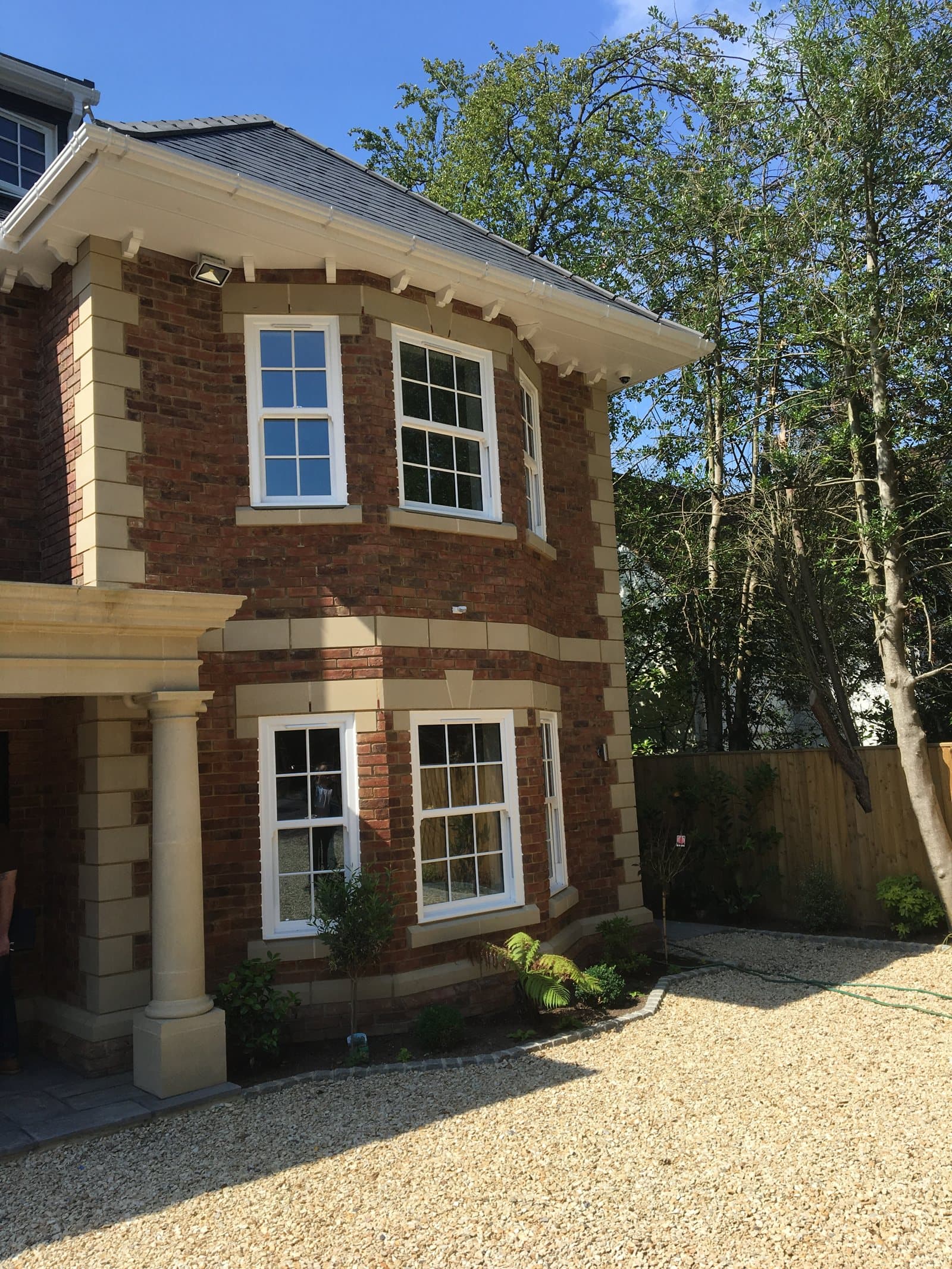
- Assuming a bay is a set of separate windows. It is one unit. Record the width of each face and the angles between them, and state whether it is a splay bay with angled returns or a box bay with square ones. The frames are built to the geometry you supply, so an approximation on the angles produces a bay that does not close up.
- Leaving the structural opening ambiguous. Say which you have given. A schedule that mixes the two across different lines is worse than one that is consistently wrong, because the error is invisible.
- Forgetting ventilation. Trickle vents are concealed and meet Part F without a bar across the head, but they need specifying. Head vents are standard and sash vents are available on request.
If a line on your schedule is uncertain, flag it rather than rounding it. An uncertain line that is queried costs a phone call. An uncertain line that is manufactured costs a window.
Lead times, delivery and the first hour on site
Lead times are confirmed in writing against your specific order before you commit, because they move with the specification and the time of year. Fix the colour, glass and glazing bar layout at the point the openings are confirmed and the programme has the most room.
Delivery is kerbside through a national depot network, anywhere in Great Britain. Someone needs to be on site to receive, check and sign for the load, and the move from the kerb to where the windows are needed is arranged by you.
Check the load against the schedule and inspect for visible damage before signing, then note anything on the delivery paperwork. Damage should be reported within 48 hours. Doing that before you book scaffolding or other trades around the delivery is what stops a small problem becoming a programme problem.
Building Regulations on a supply-only order
Replacement windows are notifiable work. On a supply-only order, notification sits with whoever installs them, so your installer registers the work or you notify Building Control directly. Where we install, the job is registered and a FENSA certificate is issued on completion, which is the document a buyer's solicitor asks for at sale.
The product data travels either way: an A+ Window Energy Rating, 1.3 W/m²K as standard and 1.2 with enhanced glazing, PAS 24: 2022 security, and Declarations of Performance under BS EN 14351, BS EN 1279 and BS EN 12150.
Developments and multiple properties
Send one schedule covering every plot or property and it is priced as a whole, with phased delivery where the programme is staged. Holding one written specification across a site is also what stops the elevations drifting apart when the work runs across several months.
Questions we get asked
Should I give structural opening sizes or finished frame sizes?
Either, as long as your schedule says clearly which one it is and uses the same basis on every line. The most common and most expensive error is a schedule that mixes the two, because the mistake is invisible until the windows arrive.
How do I record a bay window on a schedule?
As a single unit. Give the width of each face, the angles between them, and whether it is a splay bay with angled returns or a box bay with square ones. The frames are made to that geometry, so accuracy on the angles matters as much as on the widths.
Can one order cover several properties or plots?
Yes. A single schedule can carry every opening across multiple properties, each window made to its own size, priced as one order with phased delivery where works are staged. That also keeps one specification across the whole site rather than a different one per job.
Read next
- How supply only works
- How to stop condensation on sash windows
- Draughty, rattling sashes: repair or replace?
- How secure are uPVC sash windows?
- Areas we cover
Talk to us about your windows
Send a photograph of the front of the property and roughly how many windows are involved, or your schedule of sizes for a supply-only order, and we will tell you what is realistic before anyone comes out.
Call 0800 861 1450, message us on WhatsApp, or email info@sashwindowfactory.co.uk.